
For years, businesses have relied on SEO to improve their visibility on Google, attract organic traffic, and reach customers searching for their products or services.
But search behavior is changing.
People are no longer relying only on traditional search engines. They are increasingly asking detailed questions on AI-powered platforms and expecting direct, summarized answers instead of browsing through multiple websites.
This shift has introduced a new optimization discipline: GEO, or Generative Engine Optimization.
And it raises an important question for businesses already investing in SEO:
If your website is already optimized for search engines, do you really need GEO services too?
The short answer is: in many cases, yes.
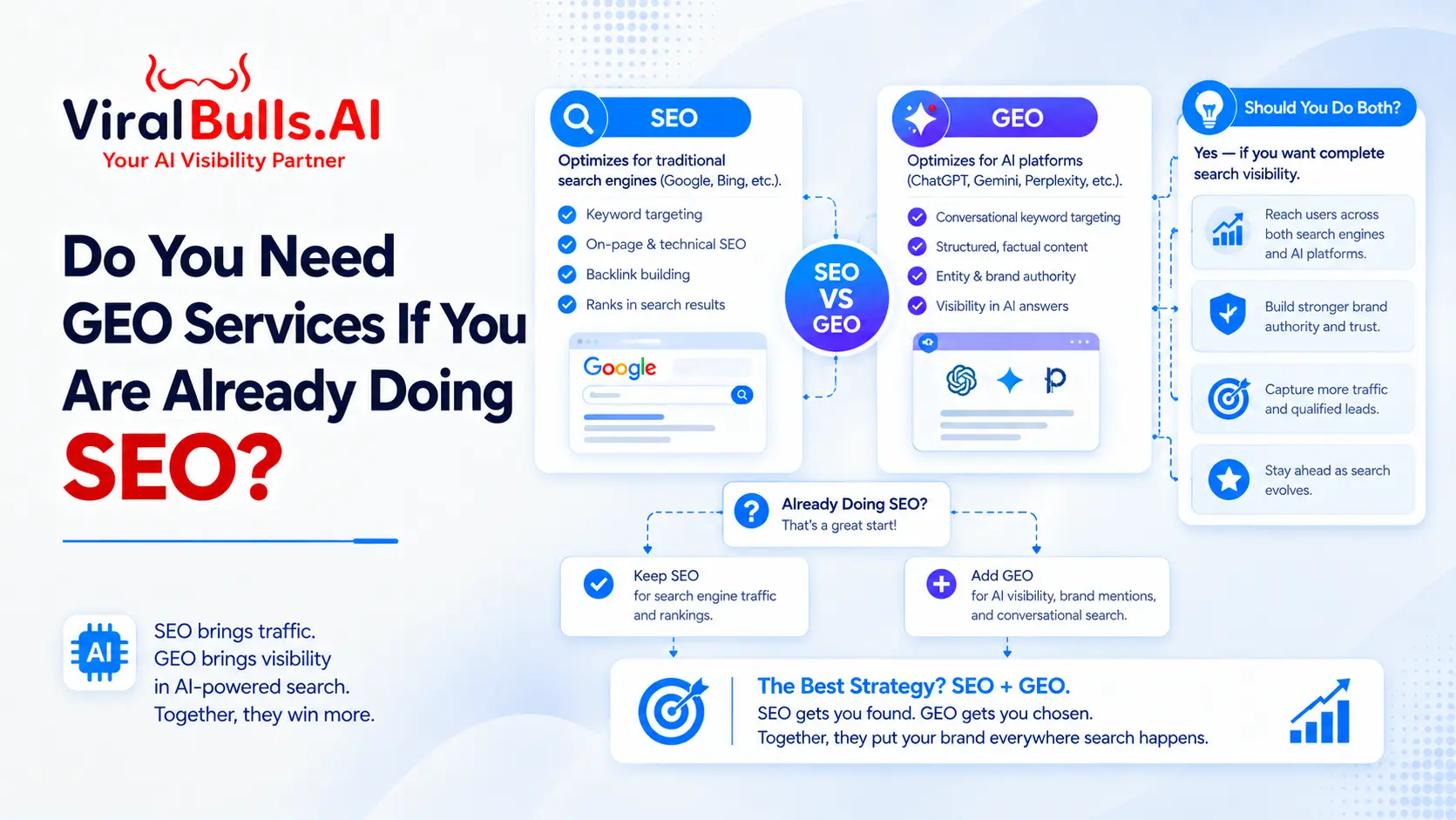
SEO and GEO overlap in several areas, but they are designed for different search environments. SEO helps your website appear in traditional search results, while GEO focuses on improving the chances that your brand, expertise, products, services, or content are understood and surfaced by generative AI systems.
Rather than replacing SEO, GEO expands your visibility strategy.
Let us understand how.
What Is SEO?
Search Engine Optimization, or SEO, is the process of improving a website so that it can rank more prominently in organic search results.
When someone searches for a service, product, question, or topic on a traditional search engine, SEO helps relevant pages become discoverable.
A complete SEO strategy generally includes:
- Keyword research
- On-page optimization
- Technical SEO
- Content creation
- Internal linking
- Link building
- Local SEO
- Website performance optimization
- Search intent analysis
- Authority building
For example, if a business offers AI marketing services, SEO may help its website rank for searches such as:
- AI marketing agency
- AI SEO services
- AI marketing company
- Digital marketing services
- AI-powered marketing solutions
The objective is usually to improve rankings, attract relevant organic visitors, and ultimately convert that traffic into leads or customers.
SEO remains an essential part of digital marketing.
However, the search journey is no longer limited to conventional search results.
What Is GEO?
GEO stands for Generative Engine Optimization.
It refers to the process of optimizing a brand’s digital presence so that generative AI platforms can better understand, interpret, reference, and potentially recommend the brand when responding to users.
Instead of optimizing primarily for a list of search results, GEO considers environments where users receive direct AI-generated answers.
For example, a user might ask:
“Which type of marketing agency can help a B2B company improve its visibility in AI-generated search results?”
Rather than receiving ten blue links, the user may receive a summarized response containing recommendations, explanations, and referenced sources.
GEO focuses on increasing the likelihood that your brand becomes part of that information ecosystem.
SEO vs GEO: What Is the Main Difference?
SEO and GEO have a shared objective:
Improving online discoverability.
But the environments in which that discoverability happens are different.
Traditional SEO asks:
“How can we make this page rank higher when someone searches for this topic?”
GEO asks:
“How can we make our brand and information clear, credible, and authoritative enough to be understood and potentially referenced by generative AI systems?”
That difference changes how marketers approach content, authority, brand mentions, website structure, and digital reputation.
SEO and GEO Compared
| Area | SEO | GEO |
|---|---|---|
| Primary Goal | Rank in organic search results | Improve visibility in generative AI answers |
| Main Environment | Traditional search engines | AI-powered answer and discovery platforms |
| Optimization Focus | Keywords, rankings, traffic | Entities, topics, authority, citations and context |
| Search Behaviour | Short and long-form queries | Detailed conversational questions |
| Content Goal | Rank and generate clicks | Become understandable and reference-worthy |
| Success Measurement | Traffic, rankings, CTR, conversions | Mentions, citations, visibility and AI recommendations |
| Authority Signals | Backlinks and domain authority | Broader reputation, citations, mentions and consistency |
| Strategy | Search-focused | Search plus AI discovery-focused |
The two disciplines are closely connected, which is precisely why businesses should not view them as competitors.
If You Already Have SEO, Why Would You Need GEO?
A common assumption is that strong SEO automatically guarantees strong visibility in generative AI results.
That is not necessarily the case.
SEO gives your business an important foundation, but GEO considers additional factors.
Here are some of the major reasons.
1. Your Customers Are Searching Differently
Traditional searches are often relatively concise.
A user might search:
“best SEO company in Noida”
But an AI-powered query might look like:
“Which digital marketing company in Noida specializes in AI-driven SEO and can help a growing B2B company improve visibility?”
The second query contains:
- Location
- Service requirement
- Business type
- Technology preference
- Desired outcome
Generative search tends to be more conversational and contextual.
Businesses therefore need content that answers deeper questions rather than relying exclusively on keyword targeting.
2. Ranking on Google Is Not the Same as Being Mentioned by AI
Imagine your website ranks well for several relevant keywords.
That is valuable.
However, when someone asks an AI platform for recommendations in your industry, your brand may still not appear.
Why?
Because generative systems may consider information from a much broader digital ecosystem.
This can include:
- Your website
- Industry publications
- Brand mentions
- Reputable directories
- News coverage
- Expert content
- Third-party references
- Reviews
- Structured information
- Authoritative sources
GEO therefore considers not only how your website ranks but also how consistently your brand is represented across the web.
3. GEO Focuses More Strongly on Entity Understanding
Traditional SEO frequently begins with keywords.
GEO puts greater emphasis on entities.
An entity could be:
- A company
- A person
- A product
- A service
- A location
- A technology
- An organization
For generative AI systems to confidently discuss your brand, they need to understand what your company actually represents.
For example, your digital presence should clearly communicate:
- Who you are
- What you offer
- Who you serve
- Where you operate
- What you specialize in
- What differentiates you
- Which topics you have expertise in
Conflicting or vague information across different websites can make this understanding weaker.
Good GEO therefore strengthens brand clarity.
4. GEO Requires Stronger Topic-Level Authority
SEO campaigns sometimes focus heavily on individual keywords.
For instance, a company might build separate pages for:
- AI SEO services
- AI marketing services
- AI search optimization
GEO requires marketers to think more broadly.
Does the entire website demonstrate meaningful expertise in AI marketing?
Supporting topics may include:
- Generative Engine Optimization
- AI-powered search
- AI visibility
- AI SEO
- LLM optimization
- AI content strategy
- Search intent
- Conversational search
- Digital authority
Covering a topic comprehensively makes it easier for both traditional search engines and AI systems to associate the brand with that subject.
5. Third-Party Mentions Become More Important
SEO professionals have long understood the importance of backlinks.
GEO expands this concept.
A backlink is useful, but the wider context surrounding a brand mention can also matter.
Suppose your company is mentioned by multiple credible websites as a specialist in AI-driven marketing.
Those references reinforce a consistent association between:
Your Brand → AI Marketing → Search Visibility → Expertise
That relationship can become valuable when AI systems gather information about companies operating in your category.
As a result, GEO may involve:
- Digital PR
- Expert contributions
- Guest articles
- Business listings
- Industry mentions
- Interviews
- Thought leadership
- Relevant citations
This is one reason why off-page visibility remains important even in an AI-first search environment.
6. GEO Encourages More Direct, Answer-Friendly Content
SEO content has sometimes become overly focused on keyword placement.
Generative AI environments reward clarity.
Content should make information easy to identify and interpret.
For example, instead of writing several paragraphs before explaining a concept, a GEO-friendly page might clearly state:
Generative Engine Optimization is the practice of improving a brand’s visibility across AI-powered search and answer platforms.
The page can then expand on that explanation.
Useful formatting may include:
- Clear definitions
- Short explanations
- Descriptive headings
- Bullet points
- Comparisons
- FAQs
- Examples
- Statistics with credible sources
- Structured data where appropriate
Interestingly, many of these practices also improve traditional SEO.
That is why GEO and SEO often reinforce one another.
Does GEO Replace SEO?
No.
Businesses should be cautious about treating GEO as a replacement for SEO.
Without strong SEO foundations, GEO efforts may become significantly weaker.
Your website still needs:
- Crawlable pages
- Logical architecture
- High-quality content
- Fast performance
- Internal linking
- Mobile usability
- Relevant keywords
- Technical optimization
- Strong authority signals
Search engines remain important discovery channels.
The smarter approach is:
SEO + GEO
rather than:
SEO vs GEO
SEO helps capture demand from traditional searches.
GEO prepares the brand for AI-assisted discovery.
Example: SEO Only vs SEO + GEO
Consider an AI software company.
SEO-Only Approach
The company might:
- Target relevant keywords
- Optimize service pages
- Publish blogs
- Build backlinks
- Improve technical SEO
- Track rankings
The strategy could successfully generate organic traffic.
SEO + GEO Approach
The same company would continue those activities but also:
- Strengthen brand entity information
- Build topic clusters around its expertise
- Answer detailed customer questions
- Earn credible industry mentions
- Improve structured data
- Publish original insights
- Strengthen expert profiles
- Maintain consistent company descriptions
- Monitor visibility across AI-powered discovery platforms
The second approach prepares the company for a broader search ecosystem.
When Should a Business Consider GEO Services?
Not every company needs to radically transform its strategy overnight.
However, GEO becomes especially relevant if:
- Your audience actively researches solutions online.
- Your industry depends heavily on expertise and recommendations.
- You are already investing significantly in SEO.
- Competitors are building stronger digital authority.
- Your buying journey involves detailed research.
- You operate in SaaS, technology, healthcare, finance, professional services, education, or B2B markets.
- You want to prepare your brand for AI-driven search behaviour.
If organic visibility is already an important acquisition channel, adding GEO becomes a logical next step.
How to Combine SEO and GEO Effectively
A successful strategy does not require creating two entirely separate marketing systems.
Businesses can integrate them.
Step 1: Strengthen Technical SEO
Ensure search engines can efficiently crawl and understand your website.
Fix issues involving:
- Indexing
- Duplicate pages
- Website speed
- Internal links
- Structured data
- Mobile usability
Technical clarity supports both traditional search and machine understanding.
Step 2: Improve Entity Signals
Make your company’s identity consistent.
Clearly define:
- Brand name
- Services
- Location
- Expertise
- Leadership
- Industries served
- Contact information
Keep this information consistent across your website and relevant external sources.
Step 3: Build Topic Clusters
Identify the major topics your business should be known for.
Create comprehensive supporting content instead of publishing unrelated articles solely for keywords.
For example:
Core Topic:
AI Marketing
Supporting Content:
- What is AI marketing?
- AI SEO vs traditional SEO
- What is GEO?
- AI visibility strategies
- Generative search optimization
- AI marketing automation
- AI content optimization
This establishes stronger topical relationships.
Step 4: Publish Original Expertise
Generic information is becoming easier to produce.
Original expertise can therefore become more valuable.
Consider including:
- Case studies
- Internal data
- Research
- Expert opinions
- Original frameworks
- Industry observations
- Customer insights
- Real examples
Give both users and AI systems a reason to consider your brand a meaningful source.
Step 5: Strengthen Off-Page Authority
Build visibility beyond your own website.
This may involve:
- Digital PR
- Guest posting
- Industry publications
- Interviews
- Strategic partnerships
- Expert commentary
- Reputable directories
The objective is not merely to collect links.
It is to build a recognizable and credible digital footprint.
How Should You Measure GEO?
SEO has established metrics such as:
- Rankings
- Organic traffic
- Impressions
- Click-through rate
- Leads
- Revenue
GEO measurement is still evolving.
Businesses can monitor indicators such as:
- Brand mentions in AI answers
- Frequency of AI citations
- Visibility for important conversational prompts
- Sources referenced by AI platforms
- Share of voice against competitors
- Growth in branded search
- Referral activity associated with AI platforms
These metrics should complement rather than replace traditional SEO performance measurement.
Final Verdict: Do You Need GEO If You Already Do SEO?
If you are already doing SEO, you are starting from the right place.
But SEO alone may no longer represent the entire search opportunity.
Search is expanding from ranking pages to generating answers.
That means businesses increasingly need to consider two questions:
Can customers find us in traditional search results?
and
Can AI-powered platforms understand, trust, and surface our brand when customers ask relevant questions?
SEO addresses the first.
GEO helps address the second.
The strongest strategy therefore does not abandon traditional SEO. It builds on it.
At Viralbulls AI, the focus is on helping businesses move beyond conventional rankings toward broader AI-powered visibility by combining SEO fundamentals with modern Generative Engine Optimization strategies.
Because the future of digital discovery will not be defined by one search channel.
Businesses will need to become searchable, understandable, credible, and discoverable everywhere their customers look for answers.